
This is the kind of thing JB Benn does: He takes $20, has it signed,. The bill disappears and reappears. It turns into a quarter that lights a cigarette that is pushed through the quarter. Someone chooses a lemon and, with the knife beside her plate, cuts it open. The signed $20 bill is sitting neatly rolled up inside the lemon. Wallace Shawn and Nell Campbell, sitting together at a dinner party, do not speak to eachother. Helena Christensen is at the party, more gorgeous and radiant than you can believe possible. No one notices. And yet everyone is intimate. As if they were all about eight years old and involved in the heady experience of dissecting a worm. There is a lot of the contented heavy breathing of fascinated concentration going on. A little absentminded dribbling. Everyone is in a different place. Everyone is all over this $20 bill and this 22 year old magician.
JB is a New Yorker of Dutch parentage who fell in love with magic when he was nine years old. He began learning the craft at fourteen and started performing two years later, when he went, nervous as hell, into Mareno’s restaurant in Irving Place. Paulina Porizkova and Ric Ocasek were at the first table he worked. They hired him for a party.
He still works in restaurants: You can catch him downstairs at E and O, Balthazar, or Spy bar, in between the odd benefit and the kind of party hosted by Herb Ritts on Christmas Eve or Joan Rivers uptown, the kind of party where Sean Connery happens to be sitting in the corner.
How JB learned all this is glossed over. He says he’s still learning, exercising his hands, honing his technique, developing new ideas and set pieces. He is busy studying for an exam on twentieth-century art history, his craft having more in common with, say, a Cubist painting-Picasso transforming a violin- than the special effects of David Copperfield. He is less interested in moving into television than in turning up in odd places at odd times when people least expect to be startled, which is, he tells me,” the beginning of the magic.”
He’s right. It is the intimacy of the restaurant table or the corner of the bar that makes JB’s craft all the more astonishing, for you suspend your disbelief without any of the usual cues or promptings. His performance seems entirely devoid of trickery or device or artifice. There he is, in a suit, at your table, this diminutive fellow, with nothing but a pack of cards and whatever else is at hand-a coin, a cigarette, a lemon- and there you are and all at once you are in a magic ring: a sexy one at that(all that shared thrill and delighted response) and you don’t just buy into it, you don’t really have the luxury of that choice. Forget about checking in your cynicism or rationality. You can practically hear your psyche reshuffling itself-making room for this phenomenal system of signs it now has to incorporate.
JB asks you to name a country, any country, and with the word just out, he folds your bill in four, and as he unfolds it you see it changing and you want to say,” Oh, come on, stop, no, come on”; but before you’ve finished these titillating protests, there it is, right there, only now it is the currency note of your country.
JB prefers to call himself a “close-up magician.” Time stops when you watch him. He begins and you fall like a stone, plop, into his box, and any defense, any learning, any experience folds up in front of you; instead you are flying on some magic carpet, and it really is up there with the best sex watching this guy, and you want to crawl inside this strange place, the arena he creates with his cards and his hands. “It is about lightness of hands,” he tells me. “That is what I had to learn, to perfect; is what I practice, lightness of hands; they are my tools” -and you never want to leave.
DAISY GARNETT
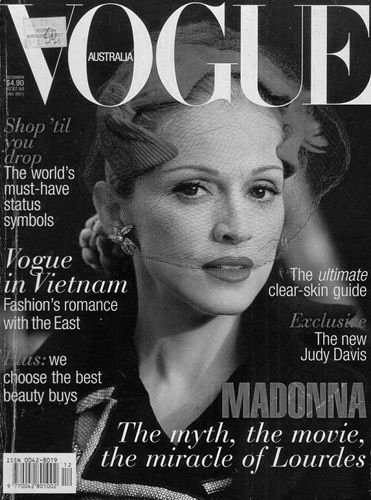
VOGUE 1997
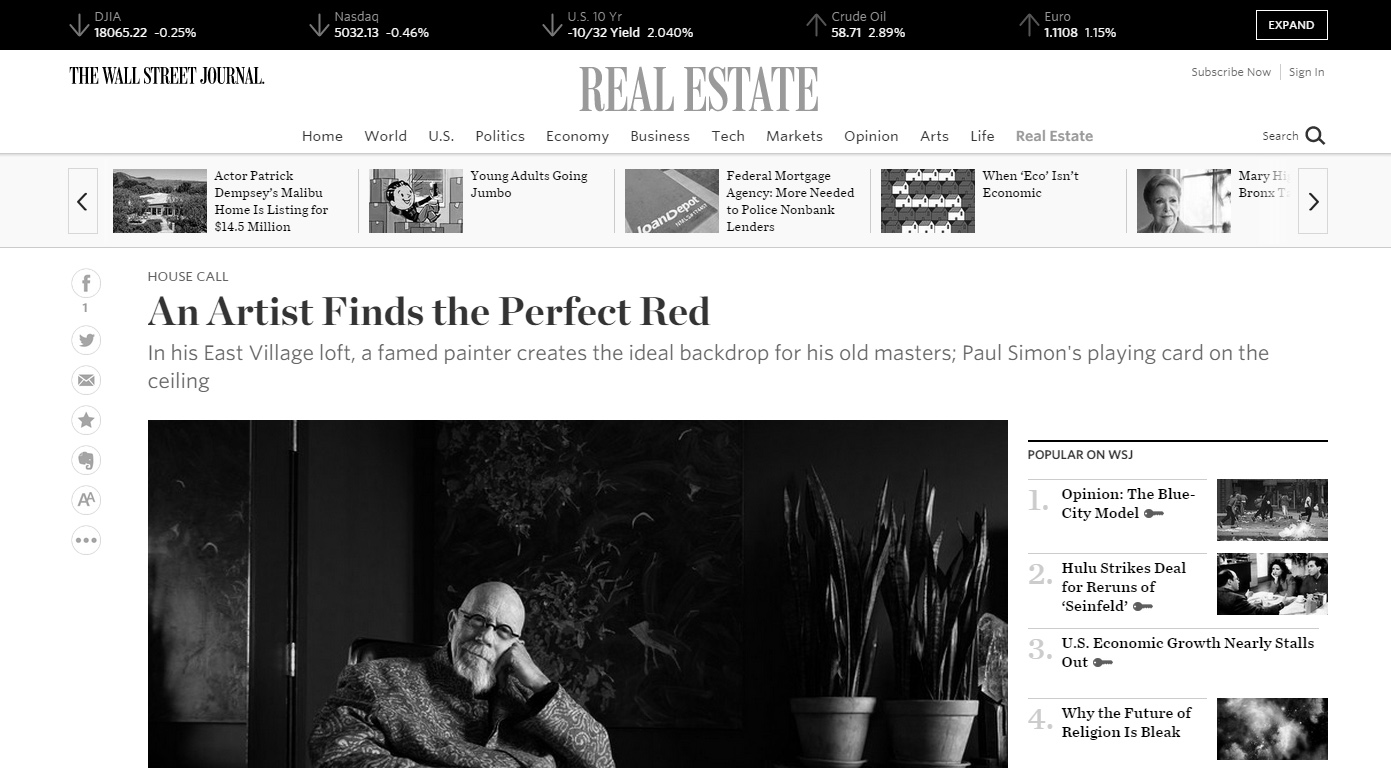
Painter-photographer Chuck Close, 73, is best known for his large-scale, photo-based portraits. His new show—”Chuck Close: Nudes 1967-2014″—is on exhibit through March 29 at New York’s Pace Gallery. He spoke with reporter Marc Myers.
Ever since a spinal blood clot left me partially paralyzed in 1988, I’ve been working from my motorized wheelchair. For years I lived in New York’s West Village, but after my divorce in 2011, I wanted to be closer to my East Village studio. I didn’t agonize over the search. I found a 3,000-square-foot loft nearby, paid too much and moved in.
The four-bedroom apartment is shaped like an “H” and takes up an entire floor of the building. The elevator opens in the apartment at center of the “H,” and when you step out, you’re in a narrow entryway facing a wall. On the wall are three free-standing oak shelves that run 25 feet and are crowded with several hundred framed paintings, drawings, prints and photos by artist-friends. The shelves give me the freedom to reshuffle the works whenever I wish.
Walls painted Cottage Red complement the old masters. ALLISON MICHAEL ORENSTEIN FOR THE WALL STREET JOURNAL
The apartment floors are polished walnut and make traveling from room to room in my chair pretty easy. The ceilings are varying heights—from 12 to 15 feet—and floor-to-ceiling windows provide lots of sunlight and views. On one side of the apartment is a balcony facing north and on the other is large terrace facing south. I collect fine art, so there isn’t much wall space left.
I used to love all-white minimalist spaces. When I moved in, I had the living room painted white, which was perfect for my black-and-white Sol LeWitt paintings and other contemporary pieces. Then I started collecting portraits by old masters from the 1300s to the 1600s. It didn’t take long to realize I couldn’t hang those paintings on white walls. They looked stupid. Visually, white was too harsh a backdrop.
Clearly, I had to find a new color. [Artist] Sienna Shields—who was my girlfriend then and is now my wife—didn’t want to be involved in picking colors. So I went to the Metropolitan Museum of Art and looked at the colors on the walls in the old-masters rooms. I also picked up dozens of Benjamin Moore color swatches and brought them back to the apartment, but none worked. Then one day at Lowe’s, I found a red with a sandstone finish called Cottage Red, by Valspar. The red was totally dead—no sheen at all. Sienna didn’t care for it. She thought the red looked like the color of dried blood.
To test it out, I painted a 4-by-8-foot foam board and put one of my old masters in front of it. The dull red was perfect, but Sienna was skeptical. She said, “Fine, if you’re going to paint the living room red, I want the bedroom black.” I thought for a moment and said, “Sure, I’ll trade you that.”
Sienna went with a greenish black. When the two rooms were done, I actually loved the bedroom and she loved the living room. In the green-black bedroom, the wall-mounted flat-screen TV seems to disappear and our tall green mother-in-law-tongue plants look lifelike. Sienna put up one of her green paintings and it looks so vivid, almost fluorescent. The room even seems larger now, and the dark color puts me to sleep instantly at night.
In the living room, the seven old masters on the walls look at home. The red doesn’t make the space seem like a European drawing room. There’s no crown molding and our furniture is modern, with a carved-wood African bed for a coffee table. We also have a minimalist gas fireplace made of polished gray cement. So the room’s design is still pretty severe—only now it has a warm color that enriches the old masters and our large collection of African sculptures.
From the time I was a kid, I’ve had prosopagnosia—or what’s called “face blindness.” I have trouble recognizing people in person, only when I have a photograph or painting of them in front of me. But when I look at a portrait, I’m less interested in the psychology of the subject. Instead, I see the portrait two different ways: I see the painting’s form—the shape and position of the face—and I see the strokes and colors and how it was done. This riffs back and forth almost like a hologram. I look at a face in a painting and just when I’ve figured it out, it flattens. It’s the push and pull of artificiality and reality. That’s why I hate realism.
In my paintings, I deconstruct a photo image—breaking it into pieces—and create a whole new image. In fact, all artworks that interest me are constructed. They don’t have to be massive works. They just have to engage me. For example, near the elevator, I have an 8-by-10-inch work by Ray Johnson featuring one of his bunny heads in black with “Bill de Kooning” written in white lettering. I also have a portrait of me by Ray. When I asked for an artist’s discount, Ray said, “Of course.” Then he cut the upper right-hand corner to match the price break.
In the kitchen we have a collection of 18 washboards and six welding masks. The masks look like a cross between African masks and Darth Vader. I rarely listen to music at home or in my studio. I don’t like having to work or live to the speed of a beat. I’d much rather find my own pulse and work at that pace. I listen to CNN or MSNBC instead.
Before I painted the living room red, we never went in there. I used to roll through it traveling from the kitchen to the den or the bedroom. Now we eat only in there. The old masters also have changed my perception. Now I notice the reds in the portraits that I hadn’t seen before, as though they had been hiding until the red walls brought them out.
I left the living room’s ceiling white—to give it height. At several recent parties, I invited magician and friend JB Benn. He performed a trick where he asks someone to select a card, sign it and return it to the deck, face down. Then the person shuffles the deck and hands it back to JB, who throws the deck up at the ceiling. Somehow, the selected card sticks to the surface, as if glued.
Paul Simon’s card—the four of spades—is still up there. I have no idea how JB does it. Like art, it’s magic.
– THE WALL STREET JOURNAL
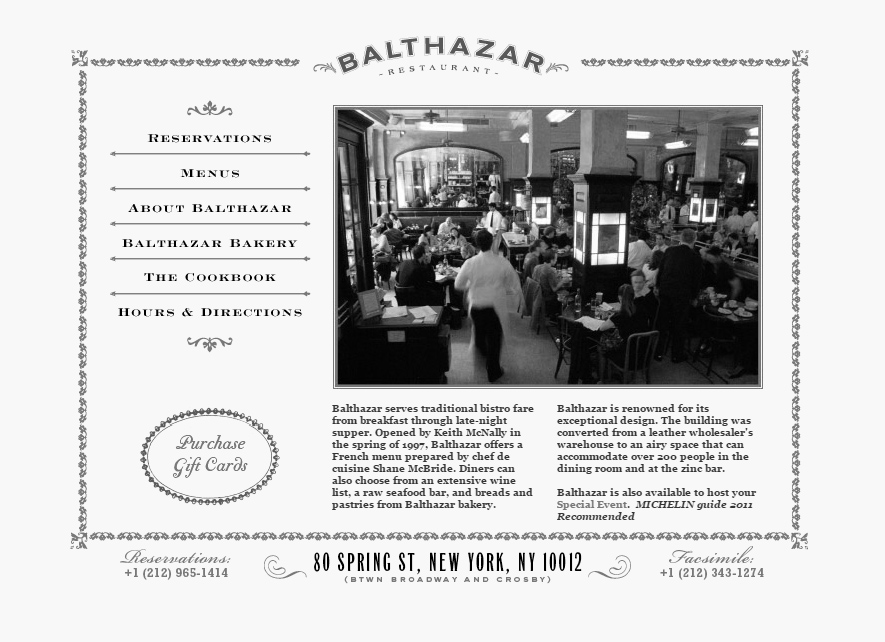
Balthazar is a restaurant of impeccable design, of course, where every detail, every square inch of McNally patina, is purposeful and calculated. The accepted bench mark for New York brasserie design, it is knocked-off a dozen times a year, at least, to varying degrees the city over. Which is why we’ve always been curious about the playing cards pasted to the ceiling (pictured above; take a look next time you’re there, they’re easy to spot). Were they really on the original design spec? Is this an inside joke in the McNally clan? We waited for Keith to take a break from his bout with Bruni, then asked him. He reveals:
“We had a magician come for a private party one time (JB Benn I think his name was), and one of his tricks was to magically send a number of playing cards way up to the ceiling where they STUCK! This absolute gospel. (But it sounds like a story, I know). Anyway, I kind of liked them there so I’ve just left them. Must be nine years now!”
Let it be known, designers: Playing cards are the new water stains.
You climb several staircases with metal doors screening out the rest of Manhattan to meet JB Benn. But then his apartment’s high ceilings and artifacts from every corner of the Earth make you feel you’ve inadvertently uttered “Open Sesame” and time and space are as fluid as they are in your imagination. For Benn, the hand isn’t just quicker than the eye-it accelerates your consciousness. “I basically do miracles in front of people,” he explains. “l’m going to bring you through magic to a higher state of awareness.” As he says this, Benn nonchalantly makes silver half-dollars appear and reappear, and turns a deck of cards into a parade of lively faces and numbers playing peekaboo on his dinner table.
“Magic entered my life completely by accident,” says Benn, who moved to the U.S. from Spain 23 years ago, when he was 2. Feats of magic began to intrigue him when he was around 7, but it was in his teens that he “discovered I was really good at magic, and had some kind of deeper connection to it.” Now Benn performs in the States half the year. The rest of the time he pursues “his greatest inspiration”: traveling to the least explored corners of the world to watch and do magic. “I go to the most faraway places nobody’s even heard of, like Burkina Faso in West Africa,which has an amazing tradition of magic.” There he has met shamans, conjurors, and healers, whose wisdom has brought “a reenergized fierceness” to his work. “Magic is what the unexplainable is. It’s religion or anything people don’t understand. Where the universe comes from- that’s magic.”
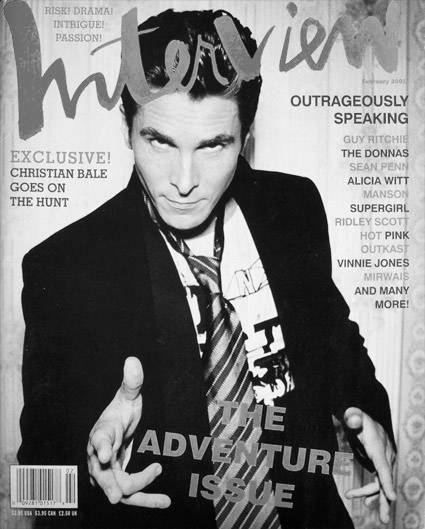
Patrick Giles is an Associate Editor at Interview
INTERVIEW February 2001
Hot day in New York, Humid. Grey, overcast and sticky. I went down to lunch at the very cool Michael’s.
Michael’s was its Wednesday jammed. Joe Armstrong with producer Joan Gelman and Robert Zimmerman; Shubert’s Gerry Schoenfeld with Clive Gillinson (Sir Clive to you and me), the executive and artistic director of Carnegie Hall, formerly managing director (and cellist) of the London Symphony Orchestra. Next door was Herb Siegel with his pal Frank Gifford, and next to them were Dr. Gerry Imber, Andy Berger and Jerry della Femina. These guys meet every week and have for years and years, always at Michael’s, sometimes two, three, sometimes six or eight. All old friends. And next to them: Kathy Lee Gifford and her colleague Hoda Kotb. Also literary agent Ed Victor and Tim Hunt; next to me: Jolie Hunt lunching with an old pal. Next week Jolie and Joe Armstrong cross the Atlantic to visit Terry Allen Kramer and Nick Simunek at their villa in St. Tropez; quelle tragique, non? Next to them, producer Jon Hart and friends. In the bay: Giants owner Woody Johnson holding forth. Around the room Bonnie Timmerman and Richard Belzer; Esquire’s David Granger with Joe Scarborough and Mika Brzezinski. At another, Wynton Marsalis with Michael Fricklag; Showtime’s Matt Blank; Nick Verbitsky and Jim Higgins; Jesse Kornbluth and Barbara O’Dair; Harry Benson and David Friend; Richard Johnson as his son Jack; Peter Price; Ed Blier and Peter Wolf; my guest: Gillian Miniter.
The illusionist, JB Benn
Meanwhile, beyond the hub-bub I noticed a guy over at the Siegel-Gifford table flashing and shuffling some playing cards (with the classic red back). Not long after Steve Millington, the restaurant GM, came over and told us this guy with the cards was an “illusionist” and that I should really meet him because “he’s amazing.” A few minutes later, Steve brought the guy over to our table, with his deck of cards handy. His name is JB Benn.
I’ve seen illusionists before. They all amaze me and I’m one of those who’s so astonished that I can’t evaluate or assess their expertise, unless they do something really unbelievable. He did one of the standard moves where he asked me to think of a card. I did: the Queen of Hearts. The next thing: he pulled it out of the deck. Then he asked me to write out my name on one side of the card, and the date on the other. I did.
Then he did a couple of “illusions” with Gillian. Then, finishing up, he remembered something in his wallet he meant to show me. Out comes the wallet, one of those large breast pocket folding ones. From it he extracted a white envelope, sealed tightly. He handed it to me and told me to open it, telling me there was something of mine in it. By now you’ve probably guessed what it was, but I had no idea: it was the Queen of Hearts card on which I’d written my name and the date.
Now, the guy never left my sight during our brief illusioning. Later, Loreal Sherman, Michael’s reception director told me JB Benn had removed her watch from her wrist (a leather strap type) without her even knowing it was gone until he later turned over a cup before her eyes under which was placed the watch. Amazing.
“Seeing is disbelieving,” is Mr. Benn’s motto. You can learn more by visiting his web site: www.jbbenn.com
Vaux-le-Vicomte may be the most famous chateau in France besides Versailles. Indeed, it is believed to have inspired the Versailles that exists today versus the Versailles that Louis XIV first began to expand from a hunting lodge to a King’s palace.
The history of the beginnings of Vaux-le-Vicomte is fairly well known but I will review it because it is so 17th romantic to this reader French history. Vaux was the creation of Nicolas Fouquet, the chief financial officer of the very young King Louis XIV who came to the throne at age five.
Countess de Vogue
In the mid-1650s, the very wealthy Fouquet commissioned the architect Louis Le Vau, the painter-decorator Charles Le Brun, and the landscape gardener Andre Le Notre to build him a chateau, a formal gardens and grounds.
Between 1656 and 1661, they created this magnificent palace. It was, in the words of the present owner Count Patrice de Vogue, “a masterpiece of classical art, the apogee of grandeur and refinement ….”
In August of that year, Fouquet gave himself a kind of house-warming, a fete in honor of the young king (he was 25). Louis was impressed; so impressed that when his new trusted adviser Colbert planted the seeds of a embezzling Fouquet in the King’s mind, he decided to arrest Fouquet and throw him in jail. This happened less than a month after the grande fete du Roi.
Colbert had much to gain, and in fact, he did. After Fouquet was jailed, tried and sentence to life in prison, Colbert took over Fouquet’s responsibilities and kept them for most of the rest of his life until his death a quarter century later. At first Louis wanted Fouquet to be executed. His trials last for three years and he was sentenced to banishment. Louis added prison for life to that. So (now) poor Fouquet – who had financed his palatial chateau with family money – never saw his magnificent creation again. Meanwhile Louis went back to Versailles with the furniture he liked from Vaux and also with its creative minds – Le Notre, Le Brun and Le Vau – to make a magnificent palace of the hunting lodge. Which they did, as we know.
Chateau Vaux-le-Vicomte
The chateau was lost to the Fouquet family soon thereafter. His wife sold it to the Marechal de Vilars of the military dynasty. This was followed by six generations of the Praslin branch of the family of the Duc de Choiseul. Then in 1875 the estate, now dilapidated and in great disrepair, was sold to Afred Sommier, a sugar industrialist. M. Sommier restored the property and it has been occupied ever since by three generations of his heirs.
After the loss of its creator and original owner, the chateau has been looked after by owners who have found a way to protect it from all the dangers and disasters of the past five centuries so that it stands as sturdily as when first built.
The book. The Countess de Vogue, Christina tells us at the beginning of this beautiful coffee table book, was born in Stockholm, the daughter of an Italian diplomat. She was brought up by a Finnish nanny called Syster who stayed with the family until her death at 91. Syster was a great cook.
Click cover to order Decadent Desserts.
An off-the-cuff cook of the most refined degree, her creations’ aromas and subsequent tastings always tantalized. Syster’s desserts and especially her cakes, especially the “sacrosanct chocolate cake,” has been served at all the birthdays of the countess’ siblings and her own children.
Surrounded by great culinary talent, the countess was for a long time an archivist and appreciator of those around her. She was a reluctant chef. After she married her husband in 1967, they hired an Austrian chef named Berthe. The countess learned the basics from Berthe, so much so that as time wore on she began to experiment on her own from cookbooks she’d accumulated or acquired from relatives.
In the year following their marriage – 1968 – they opened the chateau to the public where the countess organized a restaurant on the estate. This venture has grown in size along with the crowds (now in the six figures annually) who visit the Chateau. The countess no longer has anything to do with the restaurant. Her cookbook archiving continues as does her occasional culinary arts.
When you read this book, you want two things: to visit Vaux-le-Vicomte, and to eat its delicate desserts. The former being an impossibility for many of us, the latter is very much with the realm of access.
PUBLISHED IN NEW YORK SOCIAL DIARY

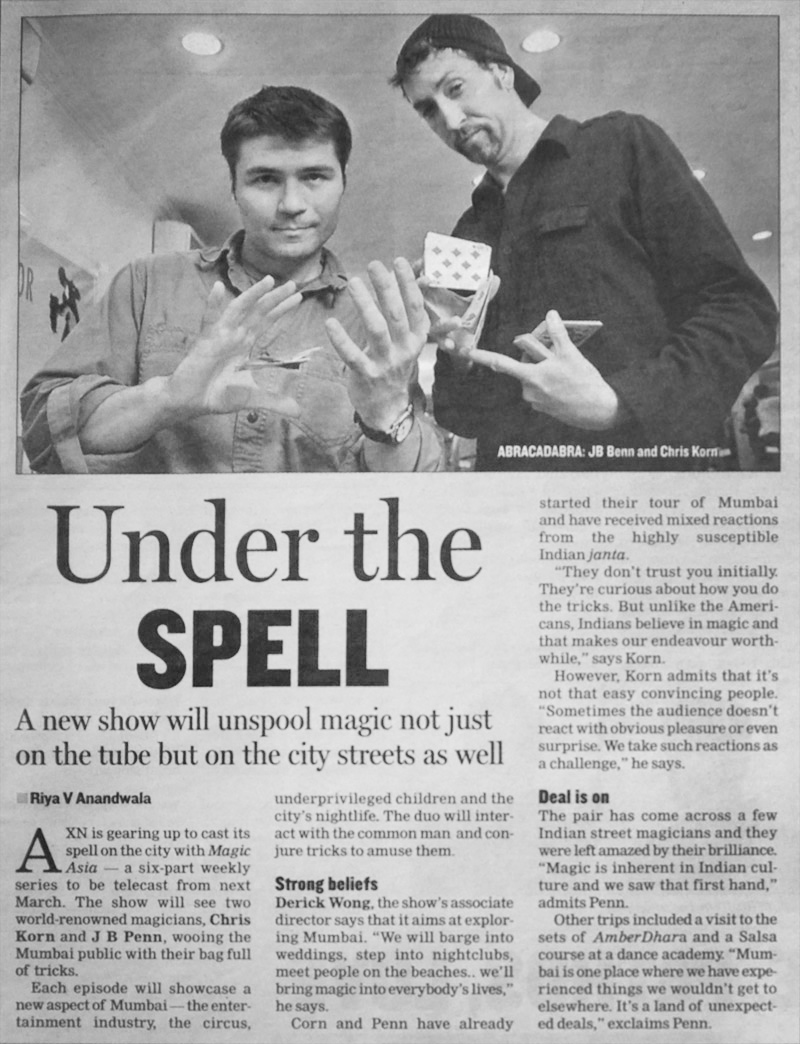
From New York to Los Angeles, London to Mumbai, JB Benn brings the world just what it needs now:
joy, amazement, and most of all, magic.